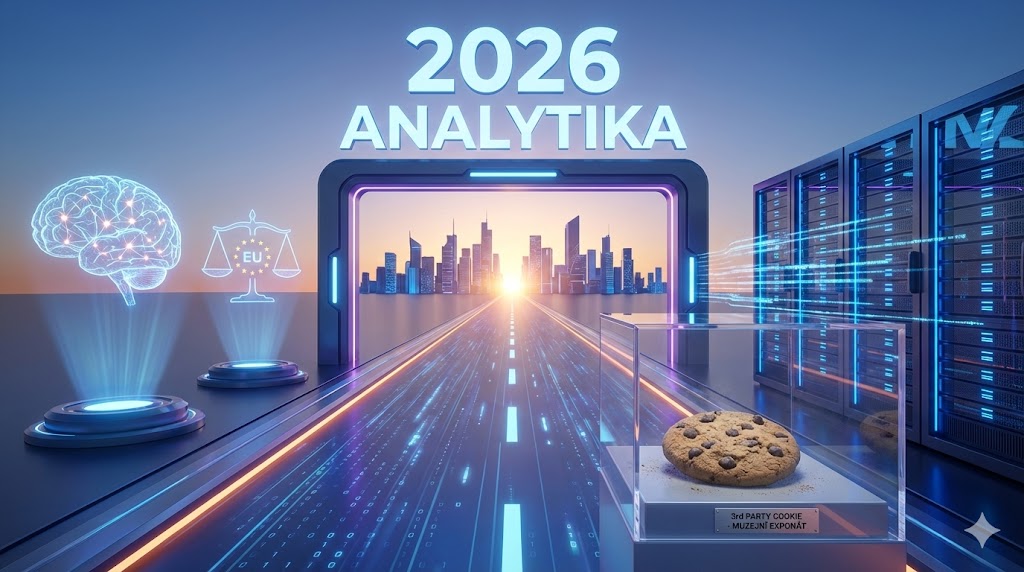
The New Year is just around the corner. I wonder what the coming year will bring. It will certainly be a lot.
1. AI everywhere
Conversation Analytics
In 2025, it became possible to “chat” about data from Google Analytics and Looker Studio, and Gemini can be used in BigQuery. In 2026, we can expect wider adoption of these tools in everyday practice.
The fundamental change will not be in what we ask of the data, but how we ask it.
Instead of a query such as “make me a report,” we will get to queries such as:
“Compare the performance of winter boot campaigns with last year and take into account that it froze a week earlier this year.”
I expect that reports as such will not disappear. Rather, they will become the basis for quick ad-hoc queries, not a final output that someone opens once a month and then closes.
AI agents
Querying data is just the beginning. In 2026, we will see the first real deployment of AI agents in analytics and marketing.
The scenario may look like this:
An agent pulls a list of high-margin products with low traffic in GA4 from BigQuery and automatically:
- increase bidding in Google Ads or Sklik,
- or add them to the priority feed.
The role of the analyst will change in such a world. They will no longer be a “report clicker,” but a supervisor who:
- defines rules,
- sets boundaries,
- and, most importantly, checks that the agent is not doing anything nonsensical.
AI in campaign management
This year, I’ve heard a lot of discussions on the topic of “Will AI replace marketers?” If we (incorrectly) reduce marketing to clicking on PPC campaigns, then yes—in many cases, it already has.
Algorithms such as Performance Max or Meta Advantage+ perform better than manually managed campaigns for many clients. Not because they are smart. But because:
- they have more data,
- they respond faster,
- they have enormous possibilities to extract information from data.
However, the basic prerequisite is data quality.
If 50% of transactions are missing from your data, algorithms will automatically work with a lower return on investment. Measuring interactions also helps optimize bidding. And if a developer implements a change that “subtly” breaks the measurement, it can kill the entire marketing performance.
In 2026, I expect significant pressure on data quality. Because the good old “garbage in, garbage out” still applies.
AEO (AI Engine Optimization)
We can expect an increase in website traffic from AI tools. At the same time, however, there will be a growing number of situations where users do not click through to the website at all.
We will address:
- how to correctly distinguish traffic from tools such as Perplexity or Gemini,
- and, above all, how to measure brand success even without a classic click-through.
I expect the search for and gradual adoption of new metrics. An example is “Share of Model” – similar to historical search engine ranking tracking, but transferred to the world of AI responses.
2. Law
Digital Omnibus
I estimate that Digital Omnibus will come into effect sometime in the second half of 2026. Unless the proposal undergoes significant changes, simple analytics for small websites could work without consent (provided other conditions are met).
At the same time, it is expected that consent status will be readable directly from browser settings or EU digital wallets.
I describe more details in a separate blog post.
Digital Fairness Act
Another piece of EU legislation in the pipeline that is worth keeping an eye on. Especially if your cookie bar is somewhere in the “gray zone.”
According to initial proposals, it should focus on:
- dark patterns,
- manipulative design,
- and generally unfair practices in the digital environment.
The proposal is expected in the second half of 2026, with effectiveness likely in 2027. Even so, it will put further pressure on working with aggregated and modeled data instead of individual user tracking.
The end of third-party cookies (sort of)
Google has been announcing for several years that Chrome will stop supporting third-party cookies. Given its market share, this would effectively spell the end for them. Personally, I don’t think Chrome will completely disable them.
On the other hand, it doesn’t really matter.
Safari and Firefox have been blocking third-party cookies for a long time, and many users have them disabled in Chrome as well. Data based on third-party cookies is no longer a big deal today.
Therefore, I expect further adoption of technologies that circumvent this problem:
- Marketing Mix Modeling (MMM),
- server-side GTM,
- Data Clean Rooms.
Marketing Mix Modeling (MMM)
MMM is experiencing a renaissance and will continue to do so in 2026.
It is an approach where we evaluate marketing based on mathematical models that track the relationship between changes in budget allocation, and sales development.
Typical considerations might look like this:
- if the costs of channel X are growing but sales are stagnating, channel X has a low contribution,
- if I reduce the budget for channel Y and sales decline, channel Y was probably important.
Yes, it’s extremely simplified. This article is not about how MMM works in detail.
In January 2025, Google released the open-source Meridian project, which you can already play around with. However, the basic condition remains the same: having data on costs (ideally also offline) in one place.
Data Clean Rooms
Data Clean Rooms allow you to securely combine your own data with data from advertising platforms without violating privacy.
Historically, it has mainly been a tool for the biggest players. However, in August 2025, Seznam launched its own Data Clean Room, which could significantly shake up the Czech market. Suddenly, it could become a relevant topic even for companies that are not purely enterprise-focused.
I will have to explore this further, but it looks very interesting.
4. Measurement codes
Server-Side GTM: no longer above standard
In 2026, purely client-side measurement will be considered insufficient for performance-oriented websites. Server-side measurement is becoming the baseline for anyone serious about digital marketing.
Typically:
- it increases data accuracy by units to tens of percent,
- gives you control over what data you send and to whom,
- and allows you to better respond to regulatory changes.
Migration wave: Microsoft UET and Seznam SEM
The first half of 2026 will be technically challenging.
- Microsoft UET CAPI – At the end of 2025, Microsoft launched support for server-to-server measurement. For Bing/Microsoft Ads, this will become practically a necessity.
Note: if you are doing B2B marketing via LinkedIn, server-to-server measurement has been supported since 2023. If you don’t have it yet, this is one of the easiest ways to improve data quality. - Seznam SEM – Starting in March 2026, Seznam will undergo a complete change in its measurement code. This means a major migration cycle, for which it will be good to plan your analysts’ capacities in advance.
5. Have you got the basics sorted?
The use of AI, MMM, and other technologies has one thing in common: it won’t work without the basics.
Specifically:
- well-designed data collection,
- all your data is in one place,
- there are mechanisms for data quality control,
- you have clear terminology, documentation, and methodologies,
- data ownership and security rules are clear.
Order in analytics will be the cornerstone for effective marketing in 2026..
I wish you all a wonderful and meaningful 2026!