When people hear “working with data,” most imagine Google Analytics and a few dashboard charts. But that’s just the tip of the iceberg.
Working with data in a company involves governance, processes, tools, data quality, security, reporting — and most importantly, the people who make sense of it all. Measurement is just one piece of the entire puzzle.
Over years of working with clients across Europe, I’ve seen companies at every level of data maturity. And one thing keeps repeating: you can’t skip levels. A company that hasn’t solved basic data hygiene can’t meaningfully deploy predictive models — no matter how good the tool it buys.
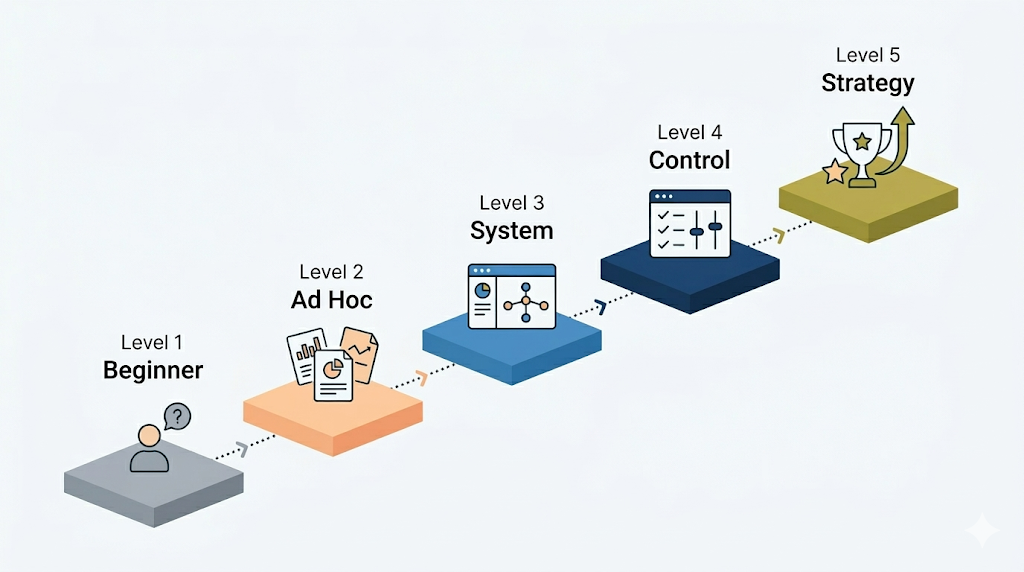
That’s why I put together a simple maturity model that helps companies figure out where they are and what comes next.
Level 1: Beginner
Nobody in the company is responsible for data. Occasionally someone from management asks for a report, but it’s unclear why they want it or what they’ll do with it. The cookie banner is either missing or misconfigured. Nobody knows how much the company spends on data — because nobody tracks it.
It sounds harsh, but it’s the reality for a surprisingly large number of companies.
Level 2: Ad hoc
Data is handled by someone who juggles twenty other responsibilities — typically a marketing manager. There’s basic measurement, basic reports like “Top 10 pages.” But every analyst (if there even is one) has their own methods, nothing is standardized. Everyone tags UTM parameters differently. Optimization is based on revenue, because no other data is available.
GA4 is running, the cookie banner works, the privacy policy is in order. That’s a good foundation — but it’s just the beginning.
Level 3: Systematic
This is where it gets interesting. The company has a designated analytics lead, a defined vision, and a budget. There are naming standards for events and metrics. A data warehouse, ETL processes, and dashboards are in place.
And most importantly: a system is forming. Methodology, processes, standardization.
This is the level most companies are trying to reach — and rightly so. It’s the foundation you can build on.
Level 4: Managed
The sponsor of data initiatives sits at the C-level. The team reviews numbers every week. Online and offline data are in one place. There’s data governance, change management, incident management. CI/CD pipelines even for measurement. Self-service BI where managers can find answers on their own.
At this level, the company has clear agreements about what data flows from where, monitors its quality, and has rules for how data is handled. It’s no longer just about “having data” — it’s about having data you can trust.
Level 5: Strategic
A member of the executive team is responsible for data. Data isn’t a support function — it’s a product the company deliberately builds. There’s one key metric the entire company aligns around, and leadership regularly evaluates it. Bonuses are tied to specific data indicators.
The company has multiple data teams, experiments systematically, measures the return on data investments, and has security and compliance built into every project from the start.
Very few companies reach this level — but this is where data stops being a cost and becomes a competitive advantage.
Where are you?
Try to honestly answer a few questions:
- Who is responsible for data at your company? A specific person with a mandate, or “someone does it on the side”?
- Do you have standards? Event naming, metric calculations, UTM conventions — or does everyone do their own thing?
- Do you trust your data? Do you regularly check quality, freshness, completeness?
- Do you know how much data costs you? And how much it earns for the company?
- Do you look at data regularly? Do you have a dedicated time block for it, or do you only check the numbers when something’s on fire?
Most companies I work with are somewhere between level 2 and 3. And that’s perfectly fine — what matters is knowing where you are and having a plan to move forward. Step by step.
What this means
Working with data isn’t just “setting up measurement.” It’s
- governance — who decides about data and is accountable for it
- processes — how data is collected, processed, and passed along
- knowledge — do the people on the team understand the data they work with?
- tools — from measurement through warehousing to visualization
- security — who has access to data and how is it protected
- quality — is the data complete, current, and trustworthy?
- culture — does the company make decisions based on data, or gut feelings?
All of these areas must grow together — otherwise blind spots emerge that can undermine even the best dashboard.
And most importantly: skipping levels doesn’t work. A company without data hygiene doesn’t need AI models. A company without clear KPIs doesn’t need real-time dashboards. Fundamentals first, then the extras.
What’s next?
- Map where you are. Go through the questions above and honestly assess yourself in each area. You don’t need to be precise — it’s about the big picture.
- Define where you want to get. Not in a year, but in the next phase. What should your data practice look like after the first set of changes?
- Set concrete steps. Pick one or two things that are holding you back the most and start there. You don’t have to solve everything at once.
Want to know exactly where you stand and what your next step should be? Get in touch — let’s figure it out together.